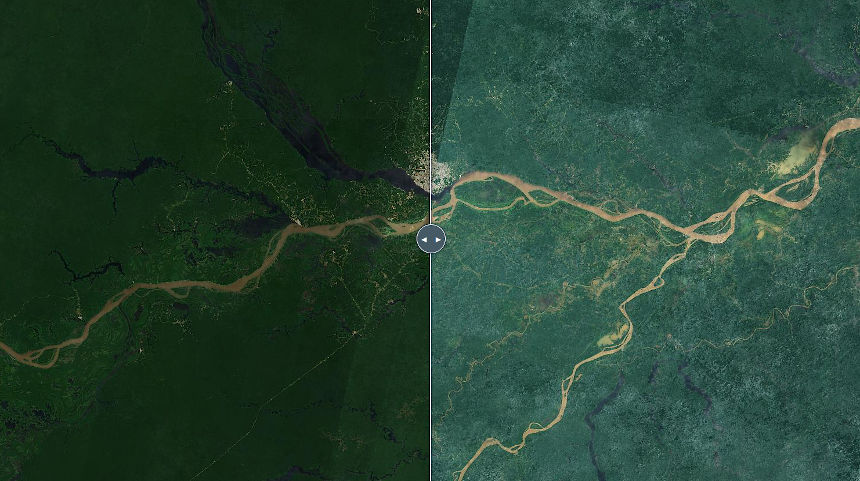
The Earth in 2024: The latest (cloud)free satellite map is waiting for you!


The global and cloudless Sentinel-2 map, crafted by EOX.

Play the EO-Guesser game and explore beautiful locations!

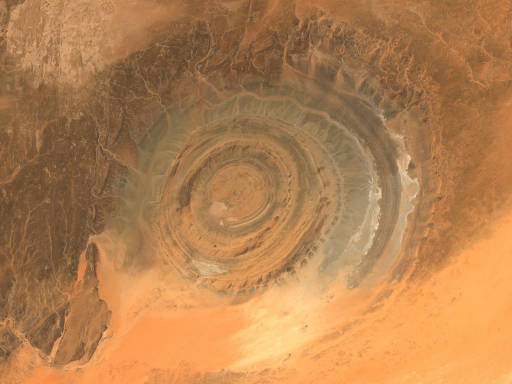
Richat Structure, Mauritania in 2022

Clearing up the weather

Endless sunshine, eternal summer - the Sentinel-2 cloudless layer combines trillions of pixels collected during differing weather conditions during each year and merges them into a sunny homogeneous mosaic, almost free from satellite and atmospheric effects. Our thanks go to the European Commission and the European Space Agency for the free, full, and open Sentinel-2 data.

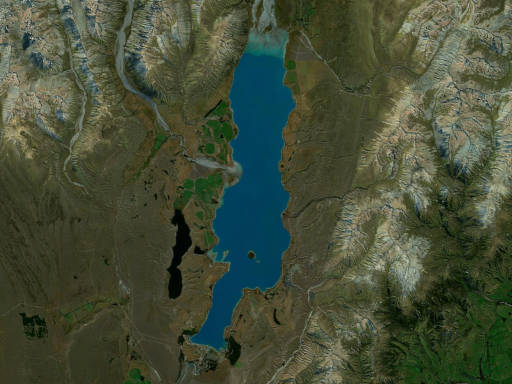
Lake Tekapo, New Zealand in 2022

Improved results

Less Clouds, Less Stripes: Bottom of the atmosphere and bidirectional reflectance distribution corrected (BRDF) data were used to make mosaic purely from the acquisitions taken in a single year gives you the opportunity to buy and use an unique satellite map.
Better Post-Processing: Sharper look, more balanced colors - our improved post-processing yields much better results in the various environments.

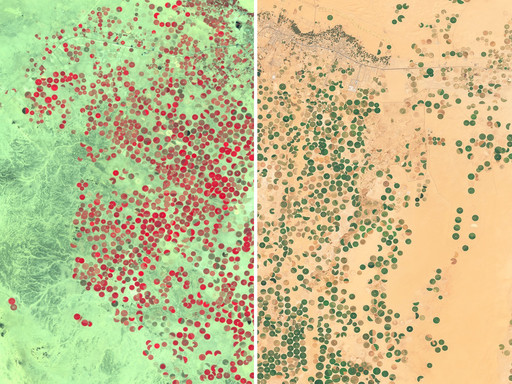
Examples for different usecases of Sentinel-2 data

Custom Solutions

Interested in cloudless satellite imagery or custom processing? EOxCloudless preprocesses raw satellite imagery to cloudless and seamless satellite data coverage. No more manual preselection of good scenes. No more unnecessary fetching of unusable data. No more data stitching. Just define time of interest and let us do the work.


Forge — the platform, the foundation. Where Geckolib meets Forge, there’s compatibility: an implicit promise that this library is intended to integrate with Minecraft Forge’s mod-loading machinery. Forge is a scaffold that lets disparate mods coexist, negotiate entity IDs, and agree on game ticks. A jar that names Forge invites expectations: proper side handling (client vs server), version-targeted hooks, and the packaging conventions that let the mod loader discover its classes and metadata.

Finally, the human element: users on forum threads troubleshooting crashes, packmakers debating pinning versions, an animator grateful when a bugfix restores smooth interpolations. The jar is more than bytes; it’s a junction where code, art, tools, and communities meet.

Technically, examining the jar could reveal actionable details: the targeted Forge and Minecraft versions, transitive dependencies (like GeckoLib’s own dependencies on animation engines or JSON parsers), the mod’s entrypoints, and whether it embeds shaded libraries or uses provided runtime ones. It could show resource conflicts (duplicated assets or overlapping namespaces) that might cause crashes. Security-wise, a jar is executable code; one would check signatures, verify sources, and, in a cautious environment, open the archive in a sandbox to inspect classes and resources.

Geckolib — a library, alive with motion. In the world of Minecraft modding it’s a familiar heartbeat: an animation toolkit that breathes life into blocky creatures. Imagine a small, nimble hand in codeland, stitching skeletons and keyframes so that tails swish and wings unfurl with believable inertia. Geckolib’s DNA is motion: interpolations, bones, poses, and the tiny offsets that prevent robotic rigidity. To modders it is both instrument and artisan, enabling models to behave less like set pieces and more like actors.

I picture the jar’s life cycle. It began as a repository: forks, pull requests, late-night debugging. A maintainer typed a meaningful commit message, squashed a bug that caused wing jitter at low frame rates. The CI ran, tests passed, and a build agent produced this artifact. Someone uploaded it to a distribution server or tossed it into a private build folder. A player downloaded it, dropped it into their mods folder, and upon relaunch, the world gained a new flourish: a dragon’s neck flexing with a believable ease, a wolf’s ears twitching toward distant sounds.

.jar — compact Java-archive skin, zipped classes and resources. Open it and you’d expect a tree of packages: com/geckolib/... or similar namespaces; a META-INF with mod metadata; model JSONs, animation files, perhaps native libraries for rendering quirks; a services file registering renderers or animation factories. Inside, alongside neatly packaged classes, might be obfuscated remnants, dependency stubs, and license files that nod to open-source lineage.
EOxCloudless Logo

Exploitation-ready Satellite Imagery

Sentinel-2 cloudless is part of the EOxCloudless Product Family, which offers source data for viewing and analysis.

Viewing Products

Get our prerendered Sentinel-2 cloudless as map cache or create your own layer using our mapping optimized source mosaics for web maps or desktop GIS tools.

See EOxCloudless Viewing Products

Data Products

Get off-the-shelf multispectral mosaic data from Sentinel-2 or define a custom mosaic tailored for your needs for further analysis and processing.

See EOxCloudless Data Products


Our products include:

  • Sentinel-2 cloudless single-file products (GeoPackage or MapCache SQLite files)
  • Sentinel-2 cloudless compressed & lossless GeoTIFFS (RGB or RGB/Nir)
  • 2016 - 2024 global Sentinel-2 data products
  • Additional sensor data (Sentinel-1 and more)
  • Fast & scalable custom processing options with additional parameters

Visit the EOxCloudless website for examples and more information!


Geckolibforge1193140jar Instant

Forge — the platform, the foundation. Where Geckolib meets Forge, there’s compatibility: an implicit promise that this library is intended to integrate with Minecraft Forge’s mod-loading machinery. Forge is a scaffold that lets disparate mods coexist, negotiate entity IDs, and agree on game ticks. A jar that names Forge invites expectations: proper side handling (client vs server), version-targeted hooks, and the packaging conventions that let the mod loader discover its classes and metadata.

Finally, the human element: users on forum threads troubleshooting crashes, packmakers debating pinning versions, an animator grateful when a bugfix restores smooth interpolations. The jar is more than bytes; it’s a junction where code, art, tools, and communities meet. geckolibforge1193140jar

Technically, examining the jar could reveal actionable details: the targeted Forge and Minecraft versions, transitive dependencies (like GeckoLib’s own dependencies on animation engines or JSON parsers), the mod’s entrypoints, and whether it embeds shaded libraries or uses provided runtime ones. It could show resource conflicts (duplicated assets or overlapping namespaces) that might cause crashes. Security-wise, a jar is executable code; one would check signatures, verify sources, and, in a cautious environment, open the archive in a sandbox to inspect classes and resources. Forge — the platform, the foundation

Geckolib — a library, alive with motion. In the world of Minecraft modding it’s a familiar heartbeat: an animation toolkit that breathes life into blocky creatures. Imagine a small, nimble hand in codeland, stitching skeletons and keyframes so that tails swish and wings unfurl with believable inertia. Geckolib’s DNA is motion: interpolations, bones, poses, and the tiny offsets that prevent robotic rigidity. To modders it is both instrument and artisan, enabling models to behave less like set pieces and more like actors. A jar that names Forge invites expectations: proper

I picture the jar’s life cycle. It began as a repository: forks, pull requests, late-night debugging. A maintainer typed a meaningful commit message, squashed a bug that caused wing jitter at low frame rates. The CI ran, tests passed, and a build agent produced this artifact. Someone uploaded it to a distribution server or tossed it into a private build folder. A player downloaded it, dropped it into their mods folder, and upon relaunch, the world gained a new flourish: a dragon’s neck flexing with a believable ease, a wolf’s ears twitching toward distant sounds.

.jar — compact Java-archive skin, zipped classes and resources. Open it and you’d expect a tree of packages: com/geckolib/... or similar namespaces; a META-INF with mod metadata; model JSONs, animation files, perhaps native libraries for rendering quirks; a services file registering renderers or animation factories. Inside, alongside neatly packaged classes, might be obfuscated remnants, dependency stubs, and license files that nod to open-source lineage.